
Sling Assessments by Established Practitioners
What do good sling assessments look like?
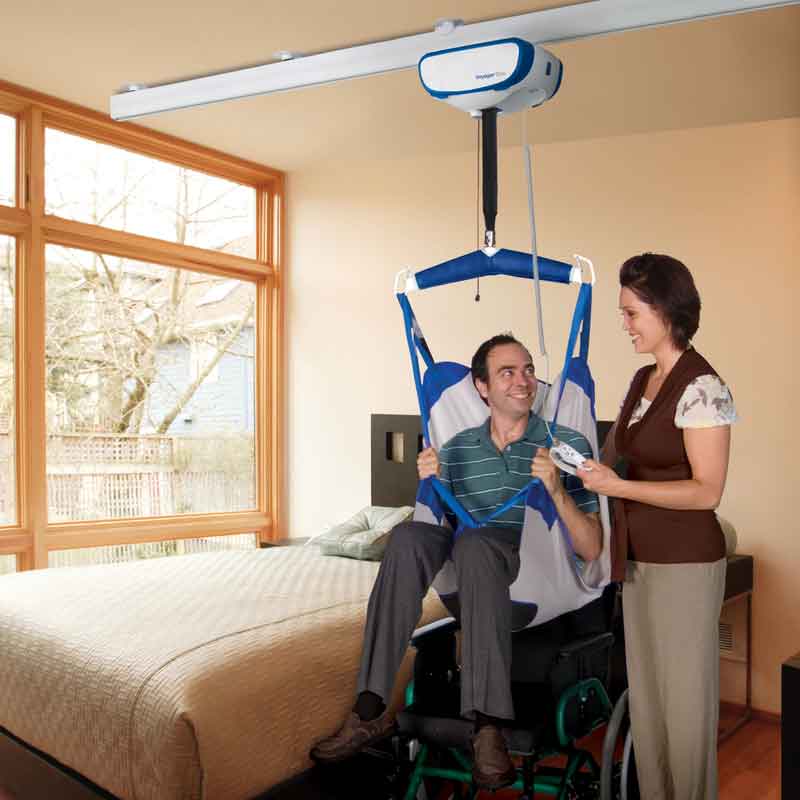
When considering assessment for a sling it is imperative that the correct selection of sling is assessed for to provide a safe, dignified and comfortable transfer. A good sling assessment needs to be completed by an Occupational Therapist who will consider all factors in relation to a person’s needs such as functional ability, diagnosis, symptoms of diagnosis, pain, medication, material used, skin integrity, a person’s size, type of equipment being used and environment.
An OT undertaking a good slings assessment will be skilled and trained will consider as follows:
- Medical condition, functional ability, sitting ability, cognitive presentation and how it may impact on hoisting due to medical condition.
- Type of transfer – which position they need to be transferred to and from. i.e. are they sitting, lying tilted or bathing.
- Comfort of the client — consideration of pain, spasms, contractures, seizures, medical devices such as catheter, drip stand/ tubing, Oxygen tubing, PEG feeds, NG Tubes.
- Interface between sling, type of hoist and spreader bar, client presentation and carer competence.
The choice of sling following assessment by the OT who is qualified to do so will depend upon:
- Physical characteristics of the person, such as height and weight, functional ability, Trunk and head control, tone, strength, hip/ leg support and tissue viability.
- Consideration of commode aperture is also assessed.
This is all considered during a functional assessment for slings and hoisting needs that an OT will undertake.
When assessing for slings an OT will further consider if a sling needs to have loops attachments or clips or combination – all dependent upon the person and environment.
Sling Specification
Sling specification will need to be identified dependent upon the outcome of the assessment, such as material, full body, insitu, aperture, head and hip tapes, inclusion of harness, shower sling, size and shape of sling, discreet pockets to store loops and use of ‘D’ rings will also be considered.
Slings with such specification require in-depth comprehensive assessment and evaluation.
Companies all have different slings for different purposes and the OT may select a certain sling brand for a person as they have experience of different types of slings to best meet assessed needs.
Bespoke additional specification may also need to be required such as: additional padding for comfort, size of aperture and materials dependent upon the evaluation. Other considerations may be in relation to short stature, slim upper half of body and larger lower half which means selected sling meets the assessed needs.
What does a poor sling assessment look like?
Care provider identifies what sling is required, whilst care providers have done a brief moving and handling course (sometimes e-learning) they do not have the skill set to assess, prescribe and review slings.
An example is a toileting sling is requested as it is easier and quicker to fit (for carers).
Assessment and/ or risk assessment as described above will not have been considered about a person’s functional ability and actual moving and handling needs.
The care provider may not have considered the persons medical needs, side effects of condition, medication and risk associated with this type of sling.
Care provider frequently orders via online forms requesting this.
Outcome: sling provided is in-correct for the person as requested by carers.
Risk posed:
- Pain from being hoisted
- Lack of postural support
- Risk of falling through aperture
- Risk of damage to tissue/ skin
- Psychological distress to person due to feeling in-secure
- Risk of injury harm (fatality)
- Potential risk to carer during the transfer
- Lack of assessment written documentation
- Inaccurate care planning
- Safeguarding
As well as risks posed the in-correct sling can mean routine use of 2 carers for moving and handling which then impacts the economy (including self-funders) as lack of cost-efficient provision.


Debbie Bissell
Address
Therapy space
Himley Hall
Himley Road
Dudley
DY3 4DF